Labour cost leakage is the share of your wage bill lost to inaccurate time capture, inefficient scheduling, pay rule errors, and manual admin. Research from KPMG puts it at 2 to 4% of total labour spend, with nearly 2 in 5 companies reporting losses of over $1 million a year. In facilities management, where labour is the highest cost on almost every contract, any loss comes straight off contract margin.
And the leak starts early, at the clock, the rota and the timesheet, long before payroll runs. The good news is, prevention starts there too. This blog covers where cost leaks come from and the 6 practices FM providers use to stop it.
Key takeaways
|
What is labour cost leakage in facilities management?
Labour cost leakage is wage spend that produces no service in return. It builds up through small, repeated errors, such as clocked hours that don’t match worked hours, cover paid at overtime rates when contracted hours were available, premiums applied to the wrong shifts, and agency staff booked because nobody could see who was free.
Employee pay makes up 40 to 60% of operating expenses at large organisations. On a cleaning, security or maintenance contract, the share runs higher still. Which means a 2% leak on the wage bill can equal the entire margin on a fixed-price contract.
At WFM we call this the Wage Leak, because the loss begins where wages are earned: at the clock and the rota:
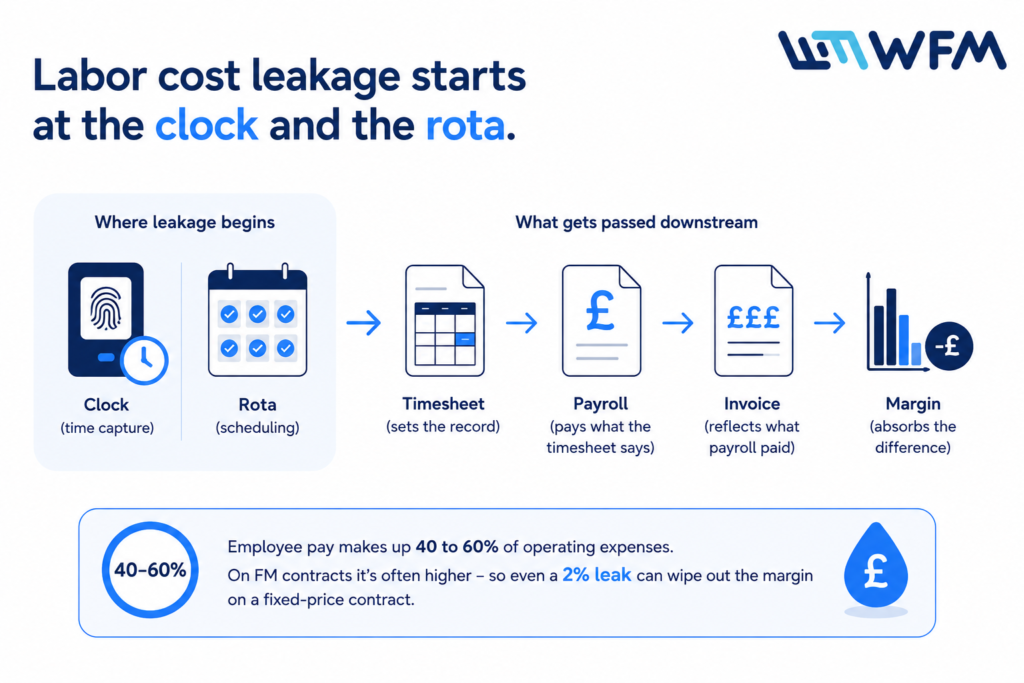
Importantly, payroll can be completely accurate and you can still have labour cost leakage. If an unnecessary overtime shift, extra 15 minutes, or incorrect premium has been approved and recorded, payroll will correctly pay it. The issue starts with the data that payroll receives.
Bottom line: Payroll pays what the timesheet says, invoices reflect what payroll paid, and margin absorbs the difference. That’s why prevention means fixing the record before it reaches payroll.
Related reading: How to improve facilities management contract margins
Why facilities management feels it more than most sectors
We tend to find there are three conditions that make FM especially exposed. Most revenue comes from fixed-price contracts, so the provider carries every cost rise until the next rebid. Labour is the biggest of those costs, and it keeps climbing: the National Living Wage rises to £12.71 an hour from April 2026. Plus competition never eases. Baachu Rain’s 2026 UK FM market report found 38% of contracts changing hands, which keeps bid pricing aggressive and margins thin.
The same report puts the market at £49.2bn, with roughly 60% of its growth coming from wage inflation and compliance costs rather than new work. Revenue is rising because wages are rising.
Plus, small discrepancies become a real problem quickly across a large FM workforce. Just 15 unnecessary paid minutes across 50 employees, twice a day, adds up to more than 9,000 hours over a year. At the 2026 National Living Wage of £12.71, that’s over £116,000 in wages before employer costs or premiums are considered.
The result: recovering leaked hours is one of the few cost controls available that leaves service levels untouched.
6 best practices that prevent labour cost leakage
Each of these six best practices helps prevent unnecessary labour costs, from clock-in through to payroll.

1. Capture time accurately at source
Accurate pay starts with an accurate record of who worked, where, and for how long. So the clocking method has to work in the environments FM staff work in, including biometric terminals for fixed sites, geofenced mobile clocking for roaming and lone workers, and hardware that survives a plant room or a washdown.
A solid clocking-in approach ends shared logins, estimated timesheets, and hours recorded from memory at the end of a week. And in FM it creates something the sector specifically needs – time-stamped attendance evidence for SLA reporting and contract audits. The same record that pays your people correctly proves the service was delivered.
2. Schedule against demand, skills, and contract rules
A rota copied from last month repeats last month’s costs, including the wasteful ones. That’s why it’s key to build each rota from what the contract requires, including the contracted hours, the skills and certifications each site needs, and the working rules that apply.
Then watch rota versus actual as the week runs. Variance caught on Tuesday is a rota fix. Variance found at month end is money already spent.
3. Handle absence before it becomes overtime
UK sickness absence has reached 9.4 days per employee a year, the highest the CIPD has recorded since 2010. And each sick day costs businesses an average of £120 in lost profits, according to the government-commissioned Keep Britain Working review.
For an FM provider, the absence itself is only half the cost. The other half is how it gets covered. When a manager can’t see who is available, the default is overtime or an agency call, both at premium rates. Absence visibility at rota level changes the order: available contracted hours first, premium labour last.
4. Approve overtime and agency hours at the point of request
Once an hour is worked, its cost is locked. So move the control to the moment the hours are committed: a request, an approval against budget, then the shift. This way, managers see the extra-hour cost before saying yes, and finance stops discovering commitments 5 weeks after they were made.
5. Build pay rules into the system
Night premiums, bank holiday rates, contract-specific terms, holiday pay for irregular-hours workers. In FM, these rules multiply, because every contract can carry its own. When the person doing the timesheets interprets them by hand, the interpretation varies by site and by week. Codified rules calculate the same answer every time, and they keep pace when rates change each April.
There’s a compliance return too. Correct application of Working Time Regulations and contracted terms is exactly what an audit tests, and a rules engine produces the evidence as a by-product of paying people.
6. Give managers labour cost visibility per contract
Monthly reporting tells you what a contract cost after you can no longer change it. Live labour cost against budget, by site and by contract, tells you while you still can. A contract manager who can see hours, premium usage and cost variance for their own sites catches the drift in week one rather than explaining it in month three.
This is the layer that turns the other five practices into margin. Accurate clocking, demand-led rotas and controlled overtime all generate good data. Visibility is what puts that data in front of the person who can act on it.
How to find out what costs you’re leaking
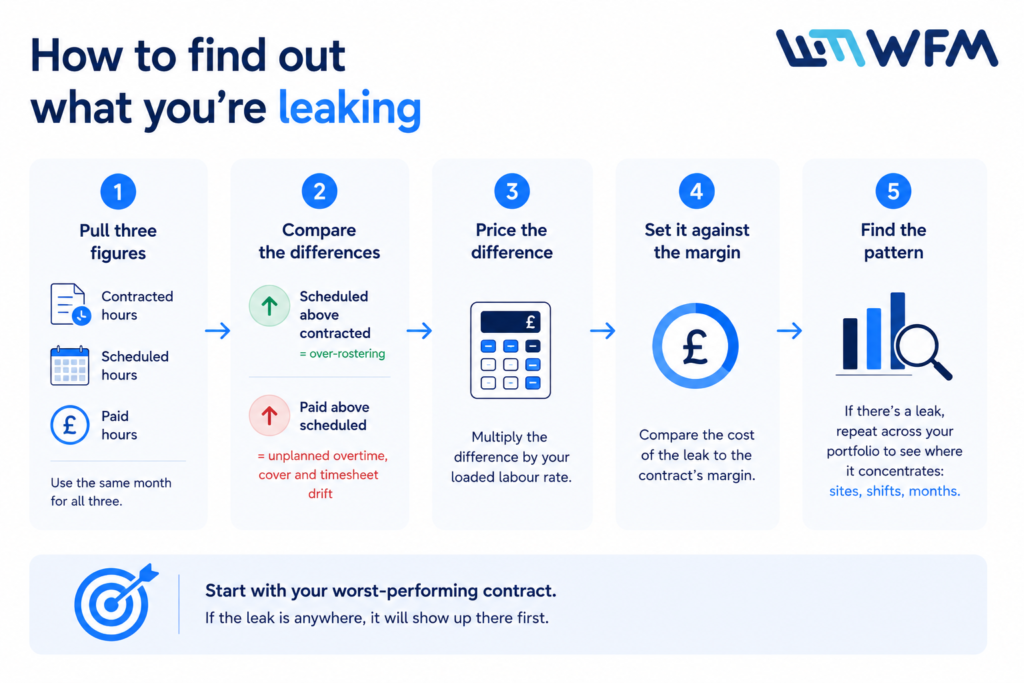
To find out what costs your facilities management firm is leaking you could start by picking one contract and pulling three figures for the same month: contracted hours, scheduled hours and paid hours. The differences between them are your starting point. Scheduled above contracted shows over-rostering. Paid above scheduled shows unplanned overtime, cover, and timesheet drift.
Then price the difference at your loaded labour rate and set it against that contract’s margin. For most providers, this takes an afternoon with payroll exports and the roster, and the result decides whether the problem deserves more attention. If one contract shows a leak, the same test across your portfolio shows where it concentrates, including certain sites, certain shifts, and certain months.
Run it on your worst-performing contract first. If the leak is anywhere, it’s there.
Stop the leak where it starts
Labour cost leakage is preventable, and prevention is cheaper than winning the revenue to replace it. At a 5% margin, every £1,000 of leaked labour takes £20,000 of new contract revenue to earn back.
The six practices in this piece all work on the same principle, which is to fix the record at the clock and the rota, and then everything downstream, from payslip to invoice to margin, gets more accurate with it.
WFM brings time and attendance, scheduling, absence and pay rules into one system built for shift-based, multi-site workforces. If you’d like to see how that looks on your own contract structure, book a demo, and we’ll walk through it with your sites and working rules in mind.
P.S. Did you know? We cover topics like this regularly. Check out our blog to go deeper, and you can follow us on LinkedIn for the latest insights.