Facilities management contract margins are under attack from every direction: wage floors rising each April, employer National Insurance up, revenue locked into fixed-price agreements, and tenders decided on decimal points. Sector analysis puts FM wage inflation at 5 to 7%, eroding margins on fixed-price contracts across the industry.
The instinct is to cut. Trim headcount, crack down on overtime, drive down agency spend. Cutting has a floor, though, and most established providers reached it years ago. The reliable way to improve facilities management contract margins is to manage labour as a performance asset, treating deployment quality, meaning who works, where, when and at what rate, as the number that decides everything else.
Key takeaways:
|
Let’s explore why the instinct to cut is reaching its limit.
Why cost-cutting alone won’t protect FM contract margins
Each cost lever works once, costs something on the second pull, and damages the contract on the third. And the underlying costs keep moving: the National Living Wage rose 4.1% to £12.71 in April, while employer National Insurance at 15% with a £5,000 threshold has pulled many part-time frontline roles into scope.
Remove too much overtime and shifts go uncovered, so SLAs slip, and penalty clauses fire. Cut headcount past the specification and the people left behind carry the load until they leave, at which point recruitment and training eat the savings. Squeeze agency spend without fixing why agency gets booked and the work simply goes undone, which costs more than the agency did.

Deployment quality has no equivalent ceiling. A contract where the right people, with the right skills, are on the right sites at the right rates produces better economics from the same wage bill, indefinitely. There’s always another week to plan better and another recurring overtime line that’s really a rostering failure with a payroll code.
This leads to costs being minimised. Assets get measured, invested in and optimised. An operations director who knows their utilisation by contract, their overtime ratio by site and their cover cost per absence is managing an asset. One who knows only the total wage bill is watching a cost, and a cost you can only watch is a cost you can only cut.
How do you improve facilities management contract margins?
You improve them through five operational disciplines that raise the quality of labour deployment: accurate time capture, demand-led planning, same-day visibility of coverage and cost, proactive absence management, and complete records of delivered work. Here is what each looks like in operation.
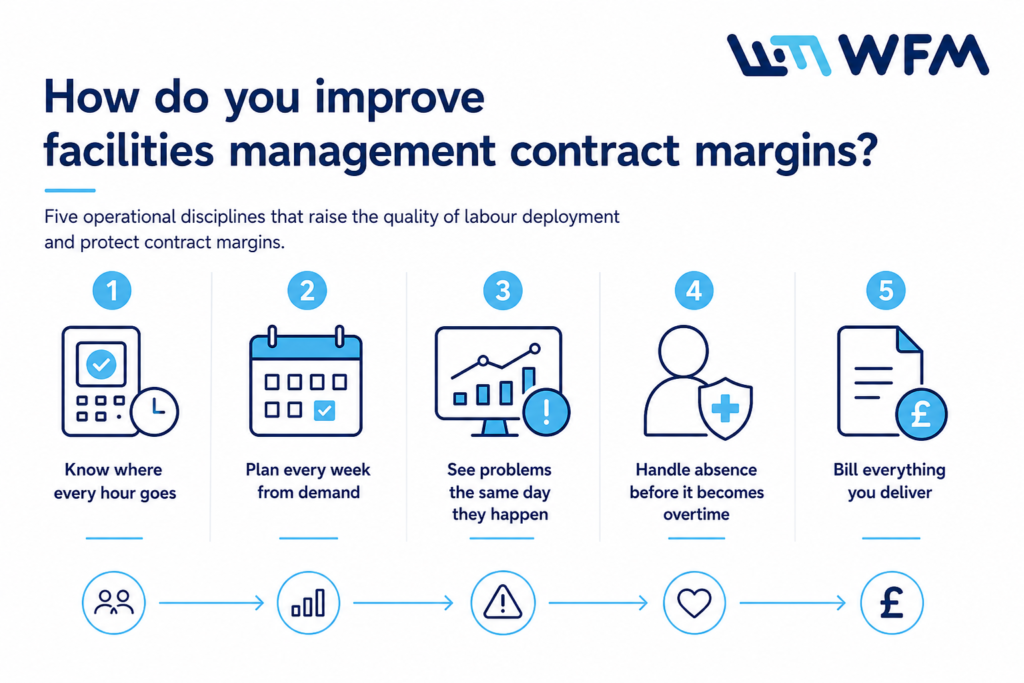
1. Know where every hour goes
Margin management starts at the clock. If recorded hours are approximate, everything built on them is approximate too: utilisation, job costing, client billing, the contract P&L itself. A site running on paper timesheets is unmeasured, and unmeasured sites drift.
The operators who do this well capture time at source, through clocking terminals or verified mobile check-ins that feed one system, so the hours in payroll are the hours that actually happened. Everything else in this piece depends on that foundation being true.
2. Plan every week from demand
A rota copied forward from last month preserves last month’s inefficiency and makes it permanent. The contract’s real requirement moves constantly: site calendars, seasonal footfall, client events, specification changes. Planning from demand means calculating what each contract needs this week, then matching people and skills to it.
Across two sites a good manager can hold this in their head. Across forty contracts with different working rules it’s arithmetic no person can do, which is why forecast-led planning is a systems capability first and a management discipline second. The providers who plan this way find capacity they were already paying for.
3. See problems the same day they happen
Coverage, attendance and cost against plan are all knowable today, and the value of knowing decays fast. A no-show identified at 6am is a redeployment. The same no-show discovered in the month-end pack is a paid absence, an SLA breach and a client conversation, all already funded.
This is the difference between correcting a problem on Tuesday and reading about it in week five. Any competent manager fixes problems they can see while the fix is still cheap. Real-time visibility is a tooling capability, and once managers have it, the month-end pack stops containing surprises.
4. Handle absence before it becomes overtime
Every uncovered shift resolved in a panic becomes premium-rate hours or an agency invoice, which means absence handling is where a meaningful share of margin gets recovered. The cost of an absence is set in the first hour: absence reported through a system can trigger the cover search immediately, finding who’s trained for the site, available, and within their working time limits, before anyone reaches for time and a half. And there’s more absence to handle than there used to be: CIPD research puts UK sickness absence at 9.4 days per employee, the highest in fifteen years.
Consistency compounds the saving. Return-to-work conversations that happen on every site, under every manager, reduce repeat absence in a way that depends on the process being automatic rather than remembered.
5. Bill everything you deliver
Scope creep and unbilled work are recording failures before they’re commercial ones. Teams do work beyond the specification, nobody logs it, and the contract absorbs the cost without anyone deciding it should.
Complete records of delivered hours, logged against contract lines as the work happens, turn the client conversation into an evidenced one. Variations get priced instead of absorbed. Extras get invoiced instead of donated. And at renewal, the provider who can show exactly what was delivered negotiates from their data instead of the client’s impressions.
What improving deployment does for contract margins
Essentially, when you improve deployment, four numbers move together:

The fourth row is the one that compounds. The two things frontline workers consistently cite, unpredictable rotas and untrusted payslips, both get fixed as a side effect of the deployment disciplines, and every leaver you don’t have to replace saves the full cycle of re-advertising, vetting and weeks of reduced productivity.
There’s a client-facing payoff too. In research among senior FM leaders, 67% said clients threaten non-renewal over perceived quality issues even while the provider believes its reporting shows the work was done. Verified deployment data closes that argument: the quarterly review starts from your record of what was delivered, rather than the client’s impression of what wasn’t.
This approach already runs at scale. One global facilities provider operates thousands of frontline staff across hundreds of UK sites this way, with verified hours feeding pay and client billing from a single record.
The asset view, one more time
None of this asks you to spend less on people. It asks you to know more about the hours you already buy, and to treat the quality of their deployment as the margin lever it is. Cutting protects this quarter. Deployment protects the contract.